Load balancing
Load balancing
for high-performance applications
If your website provides business-critical data or is your company's main source of revenue, slow response times or hardware faults that lead to an outage are unacceptable. A single server can already be affected by a short-term spike in traffic or the failure of one component, which can bring your online business to a standstill.
Layers 4 to 7
Load balancing solves these problems by distributing requests across several servers, avoiding a single point of failure. Our load-balancing solutions provide full functionality together with reliable firewall protection in one system.
- Better use of resources
- Improved scalability through easy integration of additional systems
- Less downtime during maintenance work on individual systems
- Load distribution based on server capacity and utilisation
- Support for various protocols and applications
- Increased security by isolating individual systems in the event of a fault or attack
- Better diagnostic options and faster troubleshooting
An example load-balancing solution
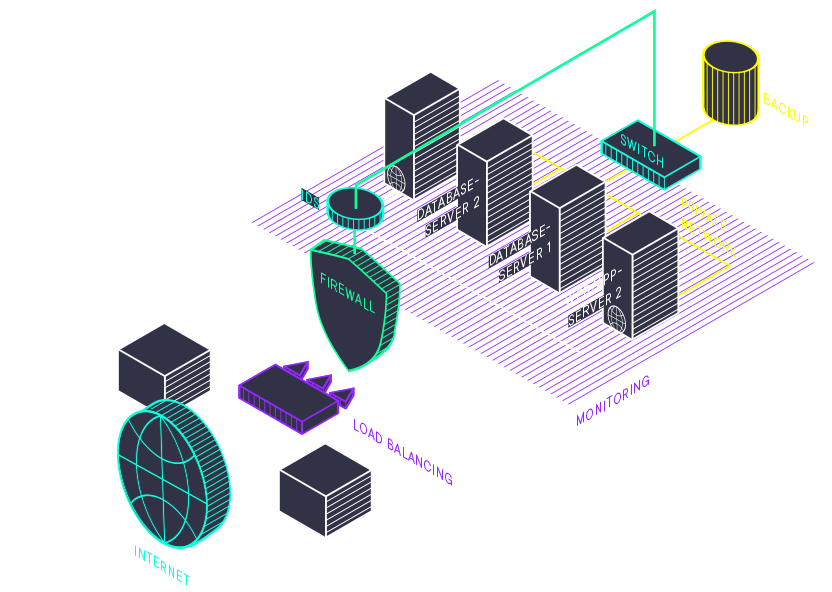
In this example, load-balancing appliances (layers 4–7) provide acceleration, security and high availability for business-critical applications.
Benefits of load balancing
Load balancing spreads the work of your dedicated system across two or more systems, making better use of resources and so improving response times.
Horizontal scaling by distributing load across several servers is more reliable and usually more cost-effective than vertically scaling solutions such as deploying expensive high-performance systems.
If a server fails for unforeseen reasons, the requests are distributed to the other servers according to predefined criteria.
As a rule, requests are forwarded to the server with the lowest load, to keep the load evenly distributed. A keep-alive check verifies that a system is available before the request is sent there. Performance and resilience increase noticeably as a result.
Three services, three levels
Load balancing, GSLB or CDN – which fits when?
Load balancing (this page)
One location, one setup. Distributes requests on layers 4 to 7 across several servers and absorbs the failure of a single system.
GSLB
Several locations, DNS level. Absorbs the failure of an entire data centre and routes requests to the appropriate location.
To GSLBCDN
Caches distributed worldwide. Shortens load times and takes load off your origin system – it does not distribute load within your setup.
To the CDNThe three do not exclude one another: a load balancer within the location, GSLB between locations and a CDN in front together make up an overall concept.
Frequently asked questions about the load balancer
What is a managed load balancer?
A system that distributes incoming requests across several servers – and that we set up, configure and run for you. You get load distribution and resilience without having to look after the appliances yourself.
What is the difference between layer 4 and layer 7?
On layer 4, traffic is distributed by IP address and port without looking at the content of the request – that is fast and protocol-independent. On layer 7, the content is evaluated, for example the requested address, so requests can be routed specifically to different systems. Our appliances work on layers 4 to 7.
What happens if a server fails?
A keep-alive check verifies before each forwarding that the target system is reachable. If a server fails, we distribute the requests to the remaining systems according to criteria defined in advance. For your users, the service remains available.
Do I need a firewall as well?
Firewall protection is included in the same system. If you also need a web application firewall, a next generation firewall or DDoS protection, you will find these services under Firewall, WAF & NGF and DDoS protection.
What is the difference between load balancing and global server load balancing?
A load balancer distributes requests across several servers within one environment. Global Server Load Balancing works one level above that, at DNS level, and distributes requests across several locations – so it absorbs the failure of an entire data centre and routes users to the location that suits them best.
Why is load distribution cheaper than a bigger server?
Because horizontal scaling – several standard systems instead of one very large one – is more reliable and usually more cost-effective than vertical scaling. You can also maintain individual systems without interrupting the service.
What response times do you commit to?
We monitor around the clock, every day of the year. How quickly we intervene and through which escalation stages is set out in your contract — a time we have not committed to is not a time we state here.
Satisfied customers
















Sovereignty
Paving the way for digital sovereignty

-
Owner-managed since 1997
As an owner-managed operator with our own data centers, we make our decisions independently and are subject exclusively to German / EU law.
-
100% made in Germany
Our data center, product development, and customer support are all based in Germany for your digital sovereignty.
-
24/7 Customer Support
We are here for you: 24/7/365 customer support, in English and German
Together we will find the right solution
We take the time to understand your requirements and develop suitable solutions. We also explain complex technical matters clearly and precisely. Feel free to contact me directly and we will find a solution.

- We will get back to you as soon as we can.
- No obligation, free of charge.