Web clusters
Clusters built
around your case
A cluster platform can run on dedicated physical hardware, in a scalable virtualised environment in our public cloud, as a private cloud, or as a mix of the two in a hybrid cloud. Which form is right follows from what you need it to withstand.
When a cluster starts to pay off
A single server is the simplest case — and the one where every failure shows immediately. A cluster spreads the work across several systems and removes, one after another, the places where a single defect stops everything.
That does not happen in one step. The five stages below describe what is added each time and what it protects against. The last stage spreads the environment across several data centres — for that we have our own sites in Hanover, Wolfsburg and Frankfurt, more than 80 and more than 250 kilometres apart, with three availability zones in Hanover.
- Separate the web and database layers
- Spread load across several systems
- Remove single points of failure
- Distribute across several sites
- Run to the agreed SLA
Five example scenarios
Five stages to high availability
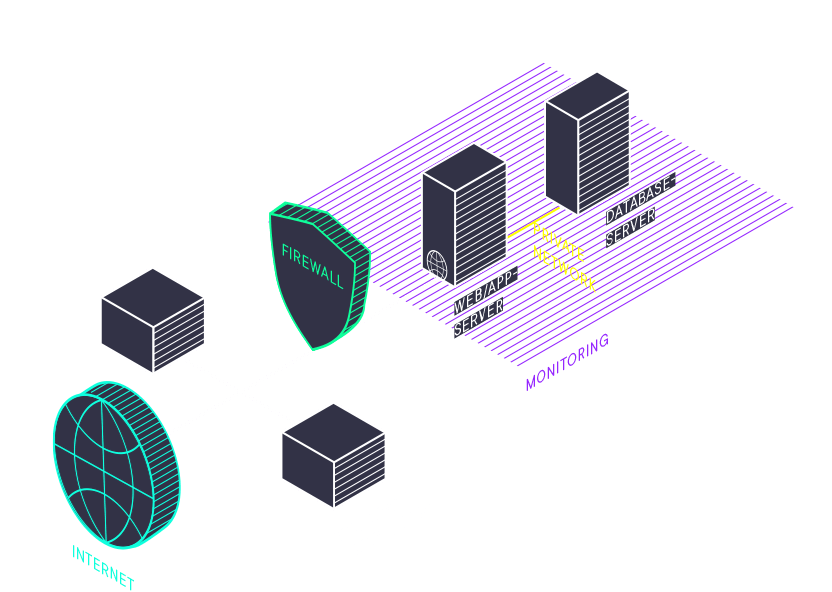
Separate web and database servers
Web or application server and database server run separately. The two layers no longer compete for the same resources, and each can be sized for its own job.
- 1 × web / application server
- 1 × database server
- 1 × firewall
- Backup (optional)
- Internal switch (optional)
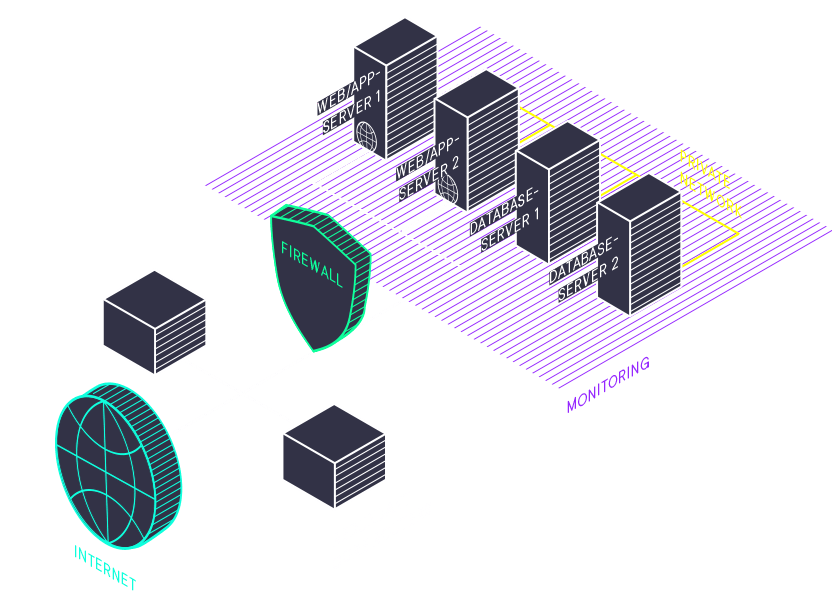
Several web and database servers
Each layer is doubled up. If one system fails, the second carries on — and as load grows, the work is shared.
- 2 × web / application servers
- 2 × database servers
- 1 × firewall
- Backup (optional)
- Internal switch (optional)
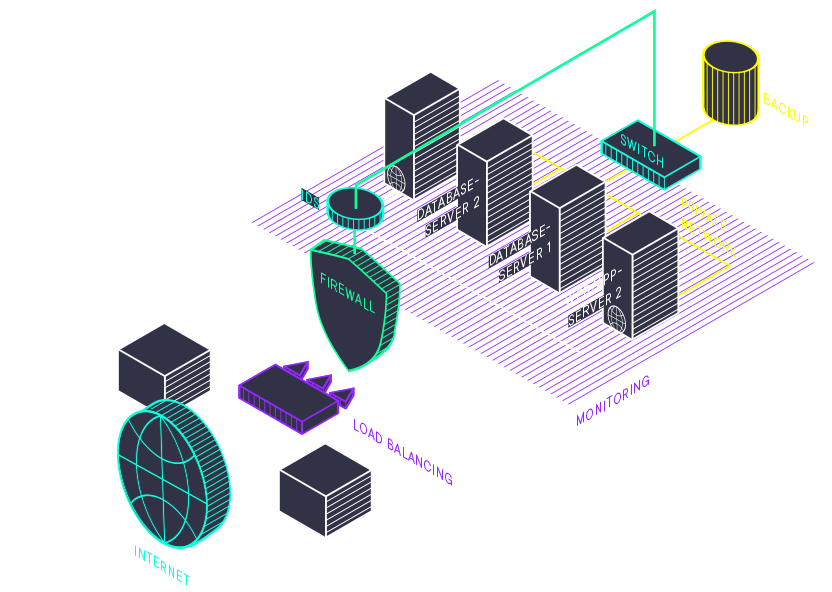
Load balancing and traffic monitoring
A load balancer distributes requests across the web and application servers, and an IDS watches the traffic. What load balancing looks like as a service in its own right is set out under load balancing.
- 2 × web / application servers
- 2 × database servers
- 1 × firewall
- Hardware load balancing for the web / application servers
- IDS / IPS and WAF (optional)
- Backup (optional)
- Internal switch (optional)
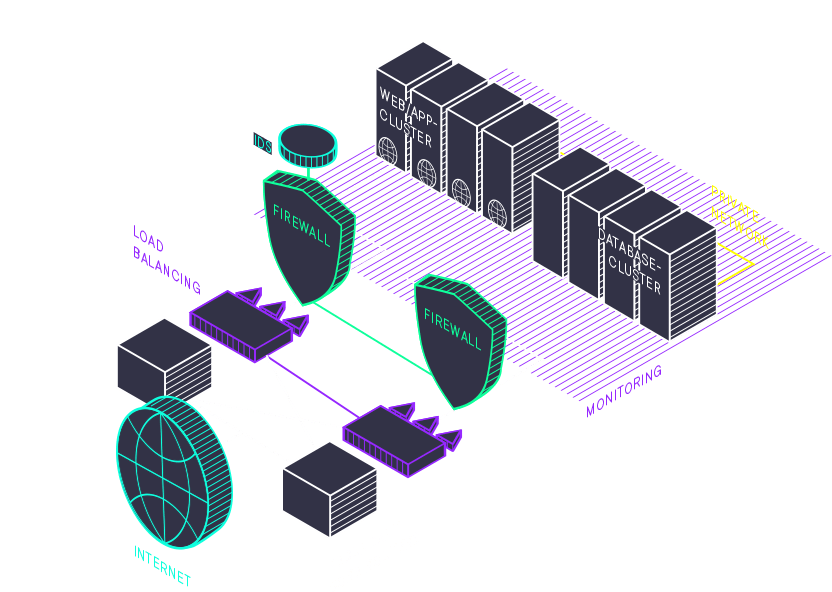
Redundancy and clustering
Every component is doubled up — firewalls, load balancers, switches. The point of this stage is that no single device can bring the environment to a stop.
- "n" × web / application servers
- "n" × database servers
- Redundant firewalls
- Redundant hardware load balancing across several web / application servers
- Redundant managed switches (optional)
- IDS / IPS and WAF (optional)
- Backup (optional)
Geo-redundancy across several sites
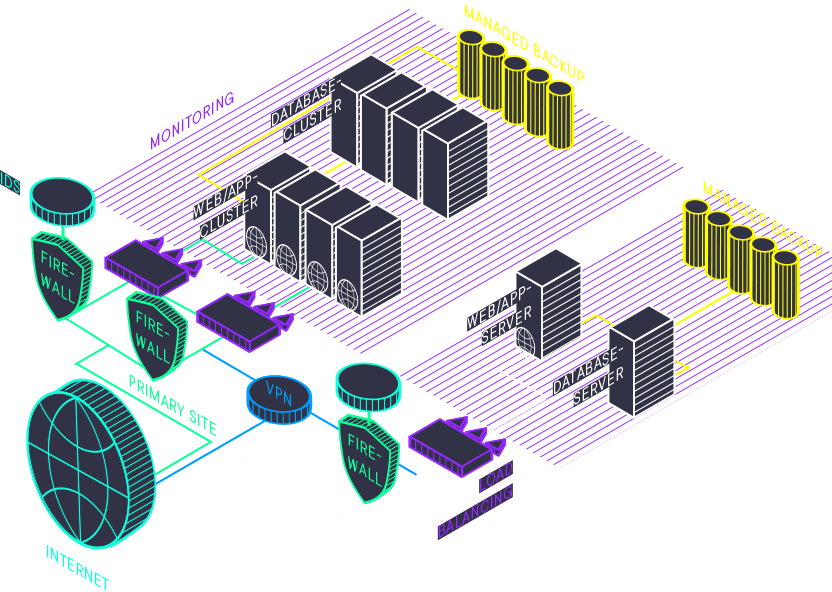
The environment is spread across two sites and connected by VPN — for disaster recovery, for failover operation, or for both. Our own data centres are in Hanover, Wolfsburg and Frankfurt; Hanover has three availability zones, and the sites are more than 80 and more than 250 kilometres apart.
Through strategic partnerships with international partners, the distribution can be built out beyond Germany as well.
- Primary site with web/app cluster and database cluster
- Second site with web and database server
- Connected by VPN
- Managed backup at both sites
- Monitoring across both sites
How we go about it
From the requirement to the running environment
We work out with you the server environment that matches your requirements — and we stay with it afterwards.
-
1
Establishing requirements
Together with you we analyse what your server environment has to do, so that the solution is cut to your requirements.
-
2
Drawing up the specification
In line with your goals, the solution is set out in a specification, taking schedule and budget into account.
-
3
Implementation
The build runs within the agreed milestones. You sign off the environment once it is provided.
-
4
Ongoing maintenance
The cluster is maintained continuously to the SLA and maintenance agreement set out for you, and scaled when needed.
What a cluster works with
Load balancing
From stage 3 on, a load balancer distributes the requests. Described as a service of its own, with its own appliance.
MoreGSLB
When the distribution is meant to happen between sites rather than within one, it works at DNS level.
MoreBackup and disaster recovery
Stage 5 is a disaster recovery architecture. Backup, restore and the regular test are part of it.
MoreThe servers underneath
Which server type forms the nodes — dedicated, virtual or hosting platform — is set out on the web servers page.
MoreFrequently asked questions about web clusters
Do I have to start at stage 5?
No. The stages build on one another, and the usual route is to build the stage that covers the risk you have now, and to lay the environment out so that the next stage stays possible later. Which one that is, we establish while working out the requirements.
Does a cluster run on physical hardware or virtually?
Either is possible — on dedicated physical hardware, in a scalable virtualised environment in our public cloud, as a private cloud, or as a mix of the two in a hybrid cloud.
How far apart are the sites?
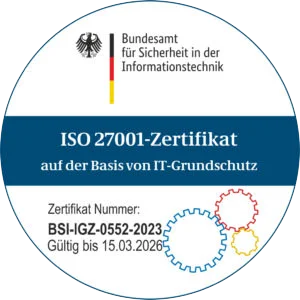
Our data centres are in Hanover, Wolfsburg and Frankfurt; the distances are more than 80 and more than 250 kilometres. Hanover additionally has three availability zones. All sites are certified to ISO 27001 based on BSI IT-Grundschutz (BSI-IGZ-0552-2023).
Who runs the cluster once it is live?
We do. The environment is maintained, monitored and scaled when needed, to the agreed SLA and maintenance agreement. Which service levels apply is set out in the contract.
What response times do you commit to?
We monitor around the clock, every day of the year. How quickly we intervene and through which escalation stages is set out in your contract — a time we have not committed to is not a time we state here.
Sovereignty
Paving the way for digital sovereignty
-
Owner-managed since 1997
As an owner-managed operator with our own data centers, we make our decisions independently and are subject exclusively to German / EU law.
-
100% made in Germany
Our data center, product development, and customer support are all based in Germany for your digital sovereignty.
-
24/7 Customer Support
We are here for you: 24/7/365 customer support, in English and German
Which stage does your application need?
Tell us what may fail and what may not — we will work out the rest.
- We will get back to you as soon as we can.
- No obligation, free of charge.